
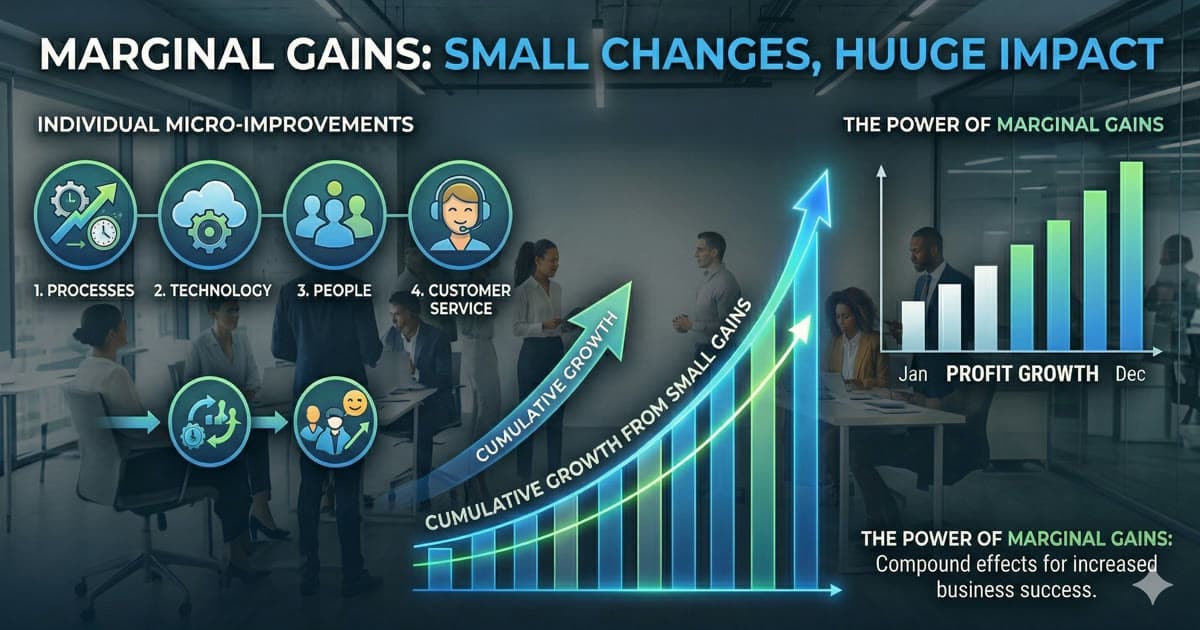
The 1% Principle
The idea of marginal gains was popularised by British Cycling coach Dave Brailsford. His philosophy was simple: if you broke down every element of performance and improved each one by just 1%, those improvements would compound into something significant.
It worked. British Cycling went from being a footnote in international competition to dominating the sport.
The principle applies equally well to business operations — and in our experience, it's far more achievable than the alternative: the large-scale digital transformation that promises everything, takes eighteen months, and rarely delivers on time.
Most businesses don't need a revolution. They need a series of small, well-placed improvements. And those improvements, accumulated over time, add up to something that looks a lot like a competitive advantage.
Where Friction Hides
Friction in business operations is often invisible until you look for it. It hides in the gaps between systems — the moment where one platform ends and another begins, and a human has to bridge the two by typing something.
It hides in manual processes that have never been questioned because they've always worked well enough. It hides in the extra minute per order, the copy-paste that introduces occasional errors, the email that has to be sent before the next step can happen.
None of these things feel dramatic. But multiply them across hundreds of daily transactions and a team of people, and the cumulative cost becomes significant — both in time and in error rate.
A 60% Improvement from One Tool
Take Target 3PL's Halfords integration. The problem was specific: a marketplace requirement meant warehouse staff had to manually copy order references between two platforms — Mintsoft and Metapack — for every single Halfords order. No API access. No shortcut. Just copy, paste, verify, repeat.
Each individual transaction might add a few minutes. But at volume, across a full day's Halfords orders, that friction added up to a real bottleneck. And every manual keystroke was a potential error.
The solution was a Chrome extension — a lightweight tool that sat between the two platforms and automated the steps the human had been doing. Scan the label barcode, extract the tracking number, dispatch via API. Done.
The result: a 60% reduction in Halfords order processing time. Not from a system overhaul. From one well-targeted tool that removed three or four manual steps from a repetitive process.
That's marginal gains in practice.
Removing the Friction at the Right Moment
The Best Before It's Gone stock booking app is another example. Stock arrives at their warehouse in mixed pallets — sometimes with paperwork, often without. Each item needs to be checked against the warehouse system, priced, SKU'd if it's new, and booked in with a best-before date.
The old process required switching between systems, manual data entry, and a lot of judgement calls about what was already in the system and what wasn't.
The new process: scan a barcode. The app checks Mintsoft and BigCommerce simultaneously, pulls forward any existing data, and handles the product setup with minimal input. New item? Auto-generate a SKU. No barcode? Generate an EAN-13 on the spot. Damaged stock? Flag it — separate SKU created automatically.
Each individual saving is modest. But applied across a warehouse processing hundreds of short-dated lines a day, the cumulative impact is significant — and the error rate drops because the system is doing the tedious bits, not a person.
The Orange Button
Perhaps the clearest example of marginal gains thinking is Best Before's click and collect system.
The challenge: give local customers a professional collection experience without spending what a larger retailer would spend. The solution: a single orange button in the dispatch email — "Click here to let us know you've arrived" — that triggers a backend sequence: order lookup, status update, SMS to staff, dashboard update.
The customer experience is seamless. The staff overhead is minimal. The system has been running without issues for years.
It didn't require a new platform. It required thinking carefully about where the friction was — the moment a customer arrives and no one knows they're there — and removing it with the simplest possible tool.
Layering Improvements Over Time
One of the less-obvious benefits of marginal gains thinking is that improvements compound. A system built with extensibility in mind can absorb new functionality without needing to be rebuilt.
When Target 3PL needed a returns processing module, we added it to the Warehouse Tools app we'd already built for them. Because the original app was designed to grow, the new module slotted in cleanly — same interface, same data sources, just new capability.
The returns module itself is another marginal gain: a workflow that previously required manual logging, separate invoicing, and email updates to the client now runs end-to-end in one place. Each return is documented, correctly charged, and immediately visible to Petite Amelie on their dashboard. More accuracy, less overhead, better client relationship.
Where to Start
If you're looking to apply this thinking in your own business, the starting point is usually straightforward: find the processes that involve a human manually moving information from one place to another.
These are almost always automation candidates. They're repetitive, they're error-prone, and the people doing them are usually aware that there must be a better way — they just haven't had the time or the tool to address it.
You don't need to fix everything at once. Pick the process where the friction is highest — where the manual step causes the most delay, the most errors, or the most frustration — and remove it. Then do it again.
Over time, those improvements stack. The business that has been systematically removing friction for three years operates differently to one that hasn't. Not because of one big decision, but because of dozens of small ones.
That's the real value of marginal gains. Not the individual improvement, but the culture of looking for them — and the compounding effect of making them one by one.
Found this useful?
Share it with someone who needs to read it.